
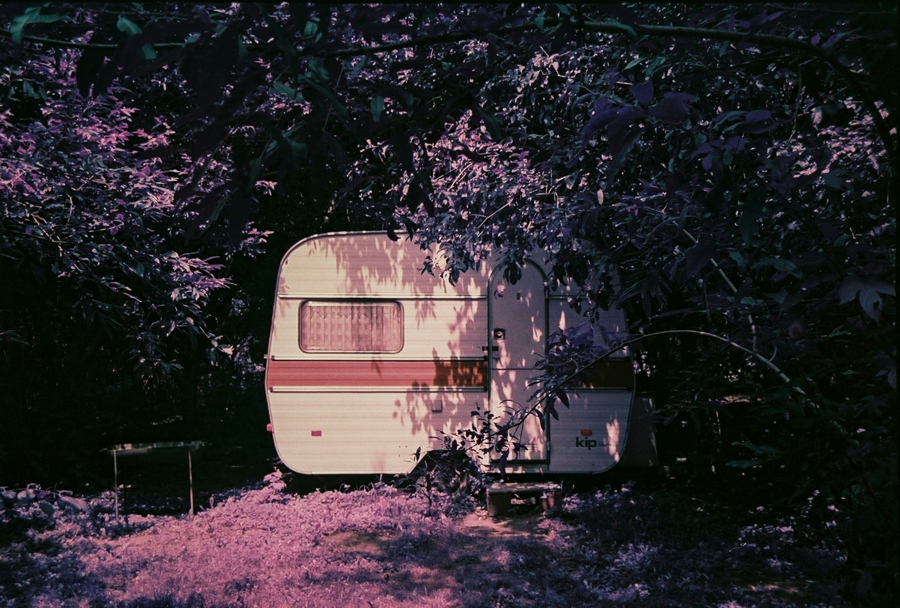
Photo by Ihor Malytskyi on Unsplash
We’re taking a little detour from the how-to this week. Everyone needs a break every now and then. Today I’ll be chatting about how I became interested in camping and campers in general. It’s funny how a few memories from childhood can last a lifetime.
So here we go…
Once I rode up to the Saco River Campground stuffed into the back of a black ’79 Camaro. My uncle Richie drove, thumping out the tunes on the steering wheel, his legs, and whatever else he could turn into a makeshift drum. He was a drummer in a band that often played the Ground Round in the next town over. My aunt Karen rode shotgun with the window open, clogs on the floor, and bleach blond hair flying all over the place, only calming at the toll booth. It was a Friday in the summer in the early 80s, so early in the 80s, it was still the 70s.
We were heading up to meet my other aunt and uncle, Debbie and Ronnie, and my cousins and best friends Jesse and ‘Lana. Harvey, my mother’s only brother, and a family Friend Tex (his real name was Austin), would come up on their own in Tex’s Firebird, which had more smoke in it than Spicoli’s van in Fast Times. Mom stayed home and probably enjoyed a nice quiet weekend.
Debbie and Ronnie were unpacking their Maverick when we rolled into the site right on the river’s edge. Everyone seemed to be smiling and laughing, joking all around, and it was just a great blip in time to be there and be 10. We were in the sun in the White Mountains in New Hampshire and general merriment was about to ensue on that long Memorial Day weekend.
That was one of my first introductions to camping, other than setting up Jesse’s orange pup tent out back in our complex and spending the night beside a little group of trees. Even though North Conway was ‘car camping’, and not that hike into the woods and sleeping under the starts sort of thing, it was still camping to me, and it juiced up my young noggin.
Almost instantly, the cars at the site stopped being cars. Now they were part of the fort that kept our food away from bears, our clothes dry, and created a makeshift barrier from whatever other imaginary dangers might lie in those mountains. For some reason, I thought it was so cool that those cars were just running north on the Spaulding Turnpike at 70 mph and now they became a silent part of our compound. Their trunks transformed into supply closets, the open doors makeshift changing stations, and the hoods became bar tops for the ice-cold Schlitz.
Hot dogs on real sticks over the campfire was the main course at night, but in the morning, the ‘grown-ups’, who were probably in their late 20s, brought out a Coleman stove. It was flat as a briefcase, but folded out to a two-burner stove, complete with a windbreak made out of the hinged lid, with two side flaps that folded out to also keep the wind down and the flames where they should be, right under the bacon. Everything they had seemed to be foldable, packable, or miniature versions of things we had at home. Toothbrushes folded into themselves, silverware had multiple uses, and Swiss Army knives, of course, could tweeze out a splinter, cut your hair, or do your taxes. It was awesome. I was fascinated by this stuff.

Uncle Richie had a late 1970s Camaro just like this cruising vessel. Photo courtesy of West Coast Classics.
From a Coleman stove to a mini house
Fast-forward that 8-track a couple of years, to just about middle school, and I was introduced to my first RV experience. If I thought a Coleman stove was the height of coolness, I was about to have my mind blown. The company my stepfather worked for offered discounts to this place called Point Sebago Resort in Maine. It was a campground, technically, with some tent areas, but mostly the place was packed with brand-new Terry Prowler campers peppered all throughout the woods and out onto a little peninsula that jutted into the lake.
From the jump, I was totally into this thing. Perhaps stemming from a need to be an architect from watching Mr. Brady, I was blown away by the camper’s engineering from, literally, the moment I stepped into — or up to — the door. First, the steps swung out from underneath the rig, like you could fold them up when driving. Then, the actual door had a screen door built right into it and I think they were magnetically sealed to each other, so you could separate them. The outer door had a latch to keep it open without it banging closed in a breeze. The screen door had a little slider so you could lock the outer door from the inside. It had a little porch light that you could turn on and off from the outside and the inside.
Inside, it had a tiny kitchen with a double sink, a mini 4-burner stove and oven, fridge, exhaust fan, countertop, toaster, cabinet space, etc. It had a bathroom with a shower and its own fan. There was a bedroom with a regular bed, but there was another bed when you folded down the dinette. The dinette cushions converted to the mattress. Then yet another when you folded down an overhead storage space. I guess that was technically a bunk, but still. It went from cabinet to a bed in two shakes. The bunk space had its own airplane-style reading lights with sliding switches. The camper also had its own heating system and air conditioning, all in this tiny 17-foot package. This uber coolness truly amazed me. Did I mention it also had outdoor storage lockers? Come on.
Fast forward the cassette this time, in high school, I was still enthralled by driving of course, but the idea of being able to drive hundreds of miles and sleep in the thing you were driving seemed so cool to me that in 1989, I bought a 1977 Dodge Tradesman cargo van that was probably a high-quality pro or DIY-build in the height of the 70s Vannin’ craze. This thing would have been awesome if it wasn’t so bad by the time I got it with rust and the like. It had wooden running boards for cryin’ out loud. It was black, came with an AC/DC Back in Black tape, had a killer stereo system with an equalizer that still worked, a CB radio, spin-around captain’s chairs, a dinette that folded down to a bed, shag carpet, a wooden octagonal steering wheel, a PADDED leather wall, a countertop, sink, and cooler for all the TaB and Pabst Blue Ribbons you could ever want in 1977. Did I mention the Cragar mags and white-letter tires? I should have since that’s the only thing that survived after it burned to the ground one night after I got some bad wiring advice. Note to Future Self: Don’t wrap a blown fuse with the aluminum foil pull tab from a fresh pack of Marlboros.
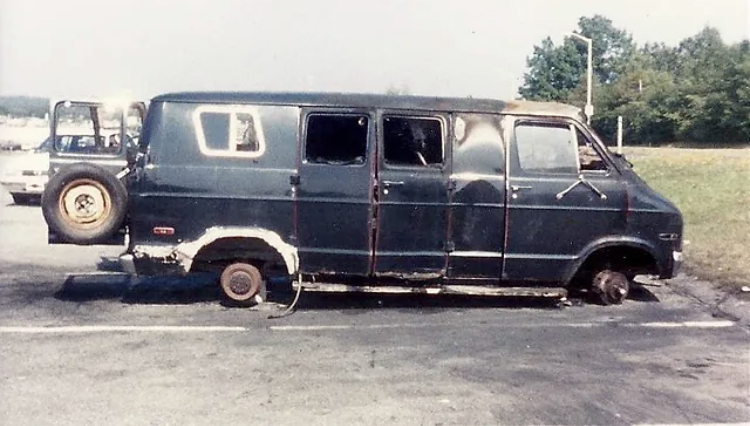
Rust in Pieces, Black.
From graduation to Nova Scotia
Skip the CD to about 10 years later when Steph and I bought a factory-built conversion van from 1984. This van was awesome too, but not quite the spectacle of the shaggin’ wagon. This thing had three giant, tinted picture windows in the back, with smaller, integrated sliders with screens at the bottom of each. It also had four velour captain’s chairs, a bench seat that folded down to a bed, a storage closet, and a built-in cooler with a drain, to get all the water out so you could add in fresh ice to chill your Bartles & James wine coolers. We took Gloria, named after the hurricane, to Nova Scotia when we graduated from URI. She was another Dodge, B250 this time, and it cruised like it was on a road made of fuzzy clouds. This was sort of a hybrid camping experience in that we brought the tent with us, but if we got trapped in the weather, we had the van to escape into if needed. We reluctantly sold her because I got a job as a reporter and the MPGs and size just didn’t make sense.
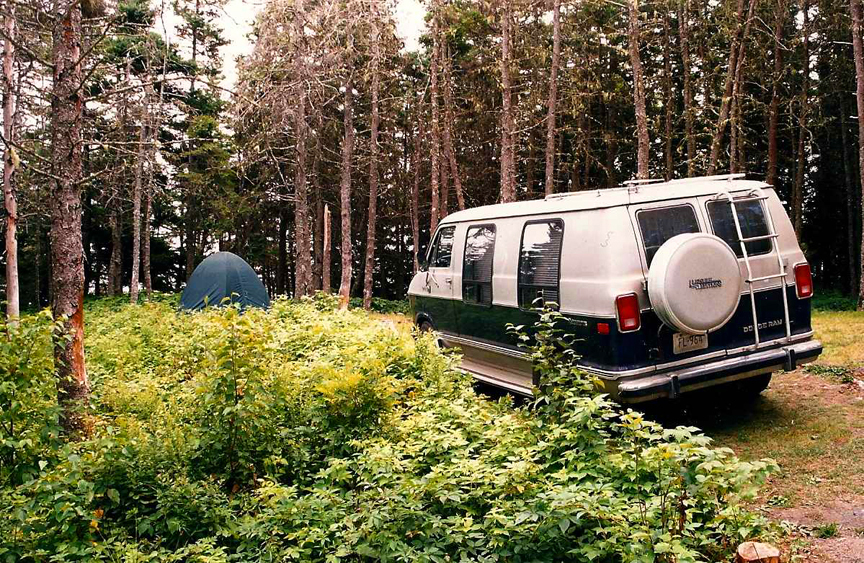
Gloria. Our 1984 Dodge B250 conversion van. We took this photo at the Bay of Fundy, on the way to Nova Scotia in 1999.
From mortarboard to drawing board!
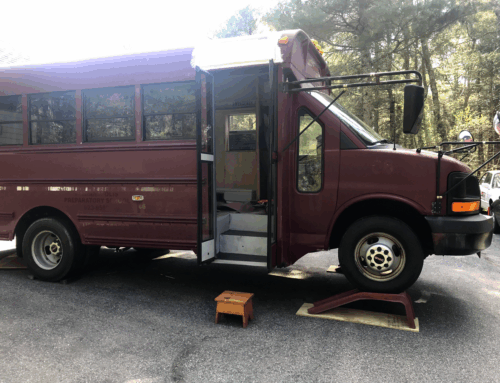
Stream to 2022, it was finally time to take all that history, adventure, and enthusiasm and put it into our bus. One of the coolest things about this whole project was the ability to design the whole thing ourselves. When it came time for floorpans and the like, we did take inspiration from other skoolie people and YouTube videos galore, but it really is our design that we hashed out over coffee while sitting in an empty bus with nothing but possibility surrounding us.
In a recent post, we talked about how we wanted a small, out-of-the-way bathroom, a wide hallway, and as much usable space as we wanted. Most skoolie people, particularly the ones with small buses like ours, typically make the bed in the back, but elevated, so there’s a ‘garage’ space underneath for the electrical system and storage. We wanted to be able to use that space though, for rally car parts, or sliding in kayaks, so we designed ours similar to that convertible bed from the camper at Point Sebago. We figured out how to fold the bed surface down, found a slider that would support our weight, but also could fold away and be open space. To make up for some of that lost storage space, we built under seat cubbies with enough room for blankets, tools, and other needed, but less used things. I wanted the electrical system sort of up close and personal so if there was ever an issue, it was easily reachable and fixable.
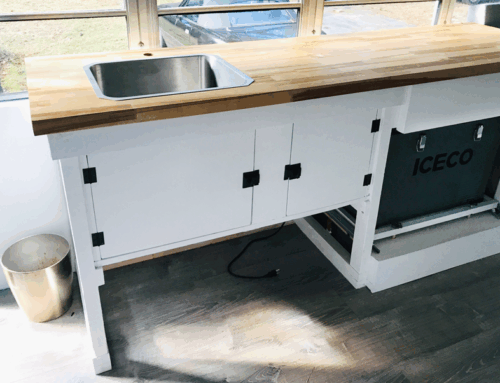
For the kitchen, we also wanted a lot of countertop space, getting inspiration from the Bona Fide Bus gang. We found a sink from a scrapyard, the cabinet from the basement of our old house, and the faucet from another skoolie build inspiration. We also didn’t want to be cluttered up and claustrophobic, so we didn’t put any cabinets up top in the bus, other than a small shelf with the depth of a Campbell’s chicken noodle soup can that ran the length of the bus. This gave us some storage for things to be out the way, like charging phones and the like, but also didn’t overwhelm the space. This little shelf also hides the tops of the curtains and provides a space to tuck them in after we roll them up for the day.
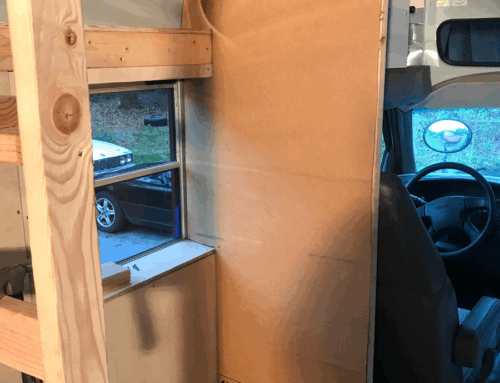
We also got to design ourselves where we put the passenger seat. Again, a lot of skoolies don’t have side-by-side seating up front (side-by-each if you’re from Rho’D’I’lin). We took inspiration from the Bona Fide people again, right down to the swiveling, folding seat that had its own integrated seatbelt. Then we got to add an air conditioner and a vent fan, just like the one in the camper at Point Sebago.
I think one of the cool things is that as a 10 year old, I could never imagine being able to do anything like this. Even 10 years ago I never imagined that we’d be able to build out a bus to our own specs. It truly is a custom rig that we designed and built. It’s pretty cool that once you set your mind to it, you can pretty much do anything.
-30-



Leave A Comment